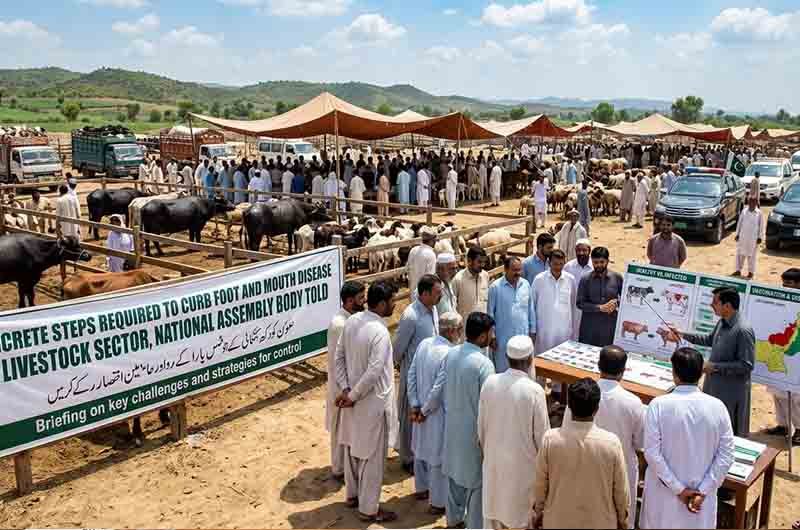
Controlling Foot-and-Mouth Disease (FMD) in the livestock sector is critical to expanding Pakistan’s meat exports, making concrete containment measures imperative, the National Assembly Standing Committee on National Food Security and Research was informed on Thursday.
Chaired by MNA Syed Hussain Tariq, the committee met following Prime Minister directives to deliberate on strategies to boost livestock, cattle, and poultry production.
Secretary Ministry of National Food Security and Research (MNFS&R), Amir Ali Ahmed, stated that livestock contributes 60 percent to the agriculture sector and approximately 15 percent to national GDP. However, FMD outbreaks significantly hurt export prices and competitiveness, forcing exporters to ship meat in boneless form at higher processing costs.
To address this, the ministry initiated work on a newly approved PC-I project for FMD control starting in 2025, alongside consultations with provincial authorities. Ahmed highlighted that 29,000 functional, accredited institutions currently handle meat exports to key markets including the UAE, Saudi Arabia, and Iran, with export approvals for Qatar and Oman underway.
Industry stakeholders highlighted several systemic constraints:
- High Production Costs: Driven by taxation, high duties, and expensive input materials.
- Financing & Support Gaps: Limited access to soft loans, minimal subsidies, and inadequate local mechanization.
- Veterinary Regulation: Difficulties importing essential veterinary medicines, machinery, and technology, alongside the need for a stronger regulatory framework to manage antibiotic use to international standards.
- Social Media Misinformation: Poultry representatives voiced concerns over online campaigns targetting chicken and eggs, requesting legislative intervention.
- Tariff Disadvantages: Poultry exporters noted a 5% UAE import duty on Pakistani products compared to 3% for Indian goods, urging government support to open markets like Qatar and lift poultry off export negative lists.
The committee instructed the MNFS&R to coordinate directly with provincial governments—since livestock remains a provincial domain following the 18th Amendment—to lower production costs, widen financing options, facilitate mechanization, and strengthen breed improvement programs.
Additionally, the Ministry of Commerce was directed to fast-track regulatory formalities through one-window operations and expand international market access through trade fairs, exhibitions, and business-to-business delegation engagements.