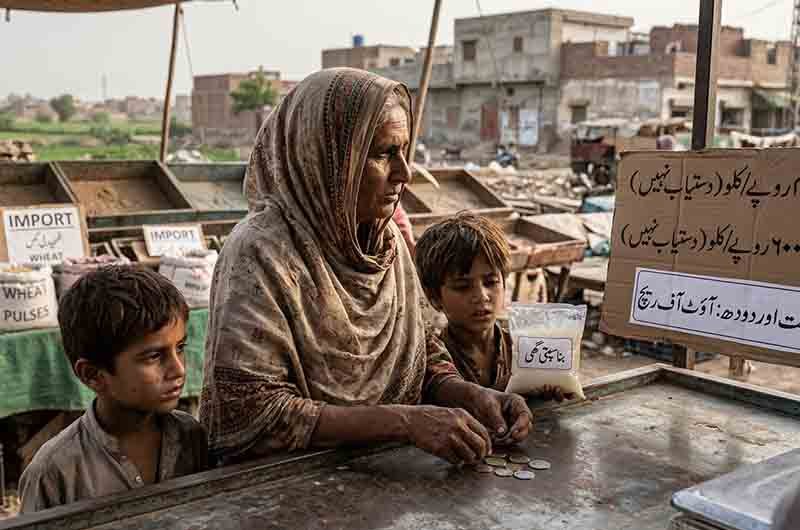
Despite its identity as an agrarian nation, Pakistan faces a severe food security crisis driven by unrelenting decade-long inflation. A recent Profit magazine report reveals a stark reality: local households have reduced their intake across almost all food categories—with the sole exception of vanaspati ghee. Once self-sufficient, the country now relies heavily on imports to meet basic dietary needs. Today, Pakistan imports roughly two-thirds of its annual pulse consumption alongside staple grains like wheat.
The Pakistan Bureau of Statistics’ latest Household Integrated Economic Survey highlights a steep decline in per capita consumption of milk and meat compared to 2019 levels. This drop in essential nutrients has caused a sharp rise in food insecurity across the country:
- Severe Food Insecurity: Risen from 2.37% of households in 2019 to 5.04%.
- Moderate to Severe Insecurity: Escalated from 15.92% to 24.35%.
Crucially, this crisis affects both rural and urban areas equally, confirming that the issue stems not merely from supply distribution bottlenecks, but from soaring food prices that have pushed basic staples out of reach for millions.
This systemic malnutrition poses a grave threat to Pakistan’s large youth population. Without adequate daily nutrition, the promise of a “youth dividend” risks turning into a tragedy of chronic malnutrition, impaired cognitive development, and long-term societal dependency.
Beyond the humanitarian toll, food insecurity presents a direct national security risk. A nation dependent on foreign imports to feed its populace becomes highly vulnerable to external pressures and geopolitical maneuvering—a vulnerability underscored by ongoing tensions surrounding the Indus Waters Treaty. Ensuring affordable, locally produced food is no longer just an economic goal, but a vital imperative for state sovereignty.