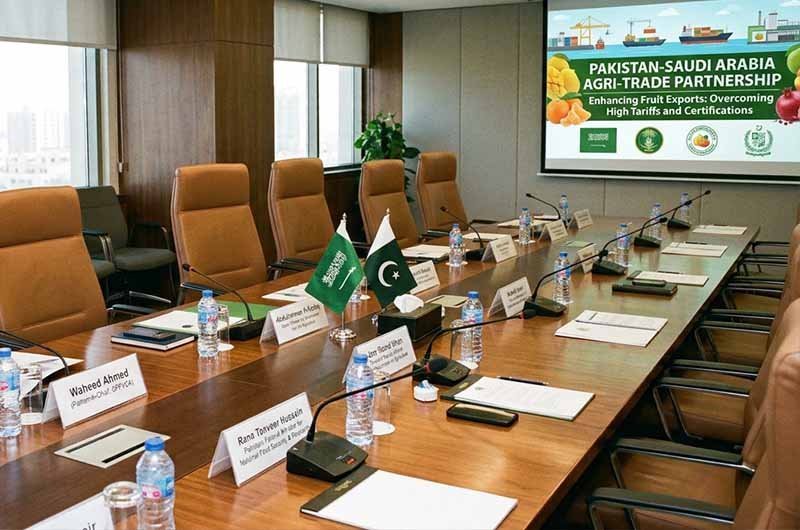
Pakistan’s value-added fruit sector is positioning itself to capture a larger share of the Saudi Arabian food and beverage market. Following the signing of the “Makkah Pact”—a tripartite defense agreement—industry leaders presented a comprehensive briefing on export potentials and operational hurdles to Saudi Arabia’s Minister of Environment, Water and Agriculture, Abdulrahman Al-Fadley.
The high-level session was attended by Federal Minister for National Food Security & Research Rana Tanveer Hussain, Federal Minister for Commerce Jam Kamal Khan, and PM’s Coordinator on Agriculture Ahmed Umair, along with senior ministry officials.
The Trade Gap & Current Standing
Waheed Ahmed, Patron-in-Chief of the All Pakistan Fruit & Vegetable Exporters Association (APFVEA), pointed out a sharp disparity between market size and Pakistan’s current export volumes:
- Saudi Import Market (2025): ~$448 million in fruit and vegetable concentrates.
- Pakistan’s Exports to KSA: $525,000 (representing less than 0.15% market share).
- Pakistan’s Global Exports (2025): 10,418 tons of fruit concentrates valued at $28 million.
While Pakistani processors already supply multinational giants like Nestlé, PepsiCo, Coca-Cola, Unilever, and Döhler, exports to KSA remain restricted by elevated tariffs, limited B2B connectivity, and regulatory hurdles regarding international certifications.
Core Strengths & Industry Potential
The sector emphasizes that Pakistan possesses the raw materials and infrastructure to meet Saudi demand reliably:
- Processing Capacity: An annual output capacity of 130,000 tons equipped with modern facilities.
- Chaunsa Mango Pulp: Features a Brix level of 22±1, providing high cost efficiencies for juice and beverage formulators.
- Quality & Compliance: Fully compliant with global standards, holding certifications including Global G.A.P., FSSC 22000, HACCP, ISO 22000, SEDEX/SMETA, and Halal.
Proposed Roadmap & Phased Supply Projections
To bridge the gap, the APFVEA recommended preferential tariff rates of 5% to 10% on fruit concentrates under an upgraded bilateral arrangement, alongside government-backed B2B networking initiative.
With investments in aseptic filling and processing capabilities, the industry outlined a phased supply trajectory to KSA:
| Timeline | Supply Capability Target |
| Short-Term (3 Months) | Up to 6,000 tons |
| Medium-Term (12 Months) | Up to 18,000 tons |
| Long-Term (3 Years) | Up to 55,000 tons |
The immediate strategy focuses on securing product registrations through the Saudi Food and Drug Authority (SFDA) to establish long-term industrial partnerships with Saudi manufacturers.