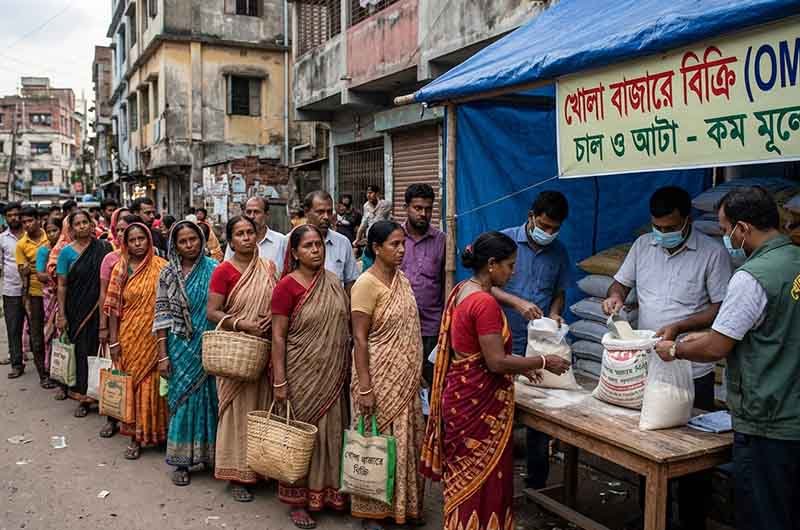
Government distribution of subsidised foodgrains dropped by 7 percent in the first quarter of the current fiscal year (July–September FY27), driven largely by a sharp reduction in Open Market Sales (OMS). Economists warn that the reduction could exacerbate food insecurity and push vulnerable households into deeper poverty.
According to Directorate General of Food data, public agencies distributed 7.55 lakh tonnes of foodgrains during Q1 FY27, down from the corresponding period last year. The slump was sharpest in Open Market Sales—which provides low-cost rice and wheat flour to low-income families—falling 22 percent to 2.05 lakh tonnes. Distributions under targeted social safety programs like Vulnerable Group Development (VGD), Vulnerable Women Benefit (VWB), and the Food Friendly Programme (FFP) saw minor increases.
Widening Vulnerability Amid Persistent Inflation
The reduction in emergency food support comes at a critical time for low-income households in Bangladesh:
- Stagnant Purchasing Power: While consumer inflation moderated slightly to an average of 8.65 percent as of September, real wage growth for unskilled laborers remains negative, further eroding household purchasing power.
- Rising Poverty Line Risks: The World Bank recently reported that 6.2 crore people in Bangladesh live just one economic shock away from falling below the poverty line. National poverty is projected to reach 22.5 percent in 2026, up from 18.7 percent in 2022.
- Growing Food Insecurity: The Food and Agriculture Organization (FAO) projected that 1.81 crore people could face acute food insecurity between September and December 2026—an 18 percent jump compared to earlier in the year.
Policy Concerns and Expert Commentary
Economic analysts have expressed concern over the government’s policy direction during a prolonged cost-of-living squeeze:
“With inflation still high and wage growth for unskilled workers lagging behind prices, households need stronger protection against falling purchasing power… With about half of the poorest households still outside social protection programmes, fiscal pressures should lead to better targeting, not weaker essential support.”
— Dr. Selim Raihan, Executive Director, SANEM
“In view of inflation, food distribution should have been increased. We see the opposite. This is not a good sign. The decline in distribution amid falling real incomes will have an impact on poverty.”
— Dr. Nazneen Ahmed, Executive Director, Centre for Policy Dialogue (CPD)