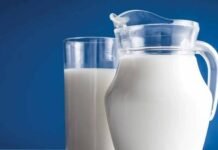
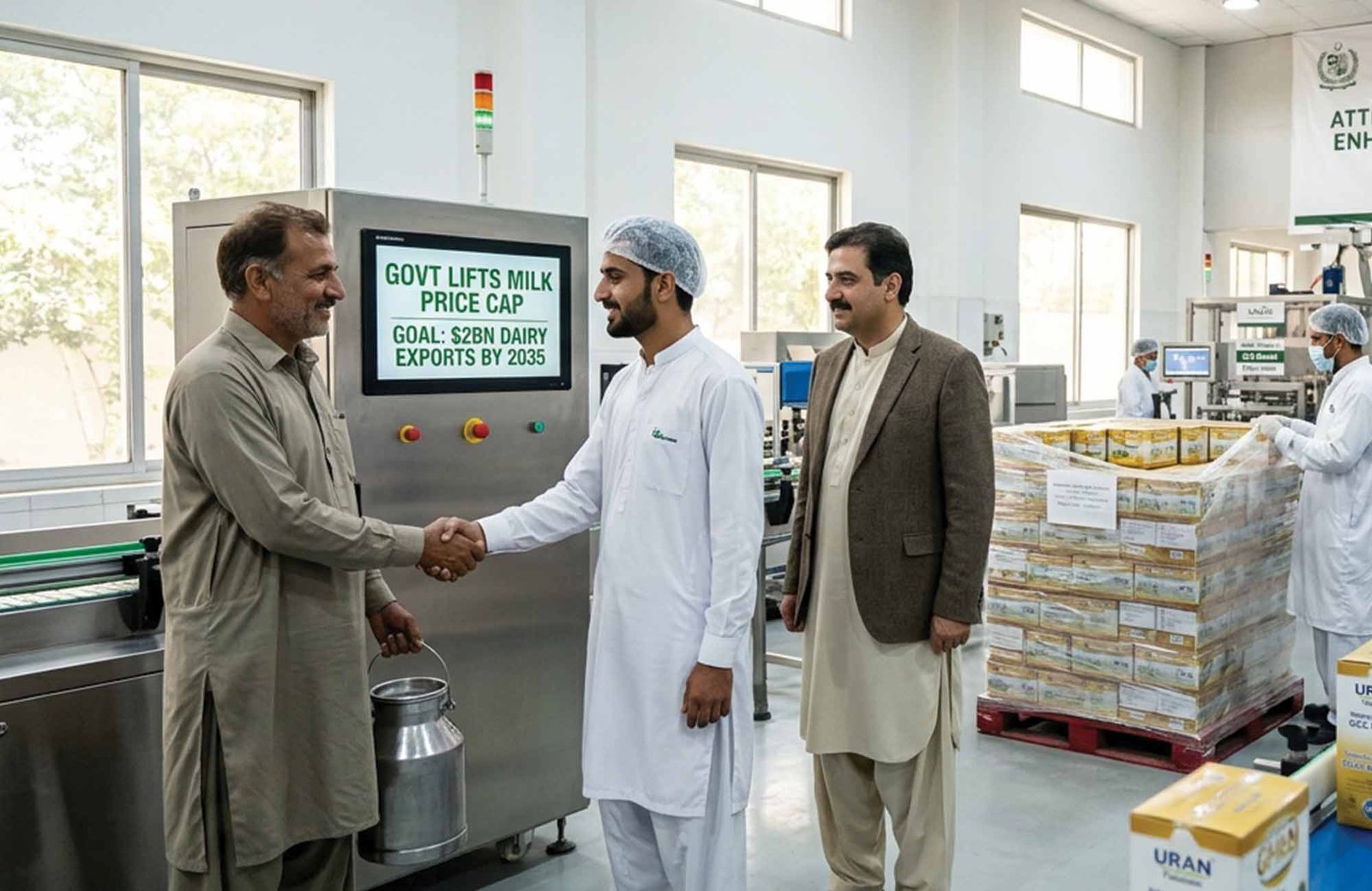
In a major economic shift aimed at transforming Pakistan from a domestic milk producer into a global agricultural powerhouse, the government is moving to liberalise the national dairy sector. Under a newly unveiled policy framework, Pakistan plans to lift price caps and remove milk from the essential commodities list to encourage private investment and target $2 billion in annual dairy exports by 2035.
The policy document, titled ‘Attracting Investment to Enhance Pakistan’s Dairy Exports,’ was developed under the government’s URAAN Pakistan initiative by the Planning Commission, the Ministry of National Food Security and Research, the Food and Agriculture Organization (FAO), and key private sector stakeholders.
From Deficit to Global Contender
Despite being the fourth-largest milk producer in the world—generating approximately 72 billion litres annually, or 7.0% of global output—Pakistan remains virtually absent from the $50 billion global dairy export market. In fact, the country recorded a $37 million dairy trade deficit in 2024.
Industry analysts attribute this gap to deep-seated systemic bottlenecks:
- Informal Channels: Over 95% of milk is distributed through unorganized traditional vendors, leaving only 5% for formal processing.
- Low Yields: Indigenous cattle breeds yield significantly lower milk volumes compared to herds in India, the U.S., or Europe.
- Price Regulations: Historic price caps maintained retail affordability but suppressed profit margins, discouraging investments in quality control and modern supply chains.
Strategic Roadmap & Export Targets
The URAAN Pakistan strategy sets progressive export benchmarks to reshape the sector:
  Current (2024)         Target (2029-30)          Target (2035)
[$37M Trade Deficit]  ──►  [$500M Exports/Year]  ──►  [$2B Exports/Year]
To achieve these targets, the government plans to position commercial enterprises as primary growth drivers. Large-scale dairy companies will consolidate smallholder farmers into cooperatives and farmer-entrepreneur groups, providing modern technology, professional training, and formal supply contracts with guaranteed quality pricing.
Major Incentives & Policy Interventions
To support private investment and modernise supply chains, the proposed framework outlines key fiscal and operational measures:
| Sector Area | Proposed Reform / Incentive |
| Taxation & Tariffs | Reduction of GST on value-added dairy products from 18% to 5%; removal or capping of import duties on dairy machinery, genetics, and feed at 5%. |
| Energy & Infrastructure | Extension of subsidized agricultural electricity rates to licensed farms/processing plants; incentives for solar-powered cold-chain chillers. |
| Livestock Financing | Creation of livestock-backed collateral loan schemes for smallholders. |
| Specialized Zones | Establishment of Dairy Export Processing Zones connected to Gwadar and Karachi ports. |
Overcoming Disease Barriers & Unlocking Regional Markets
International expansion has long been hampered by animal health challenges, particularly Foot and Mouth Disease (FMD) and Lumpy Skin Disease (LSD). The policy introduces:
- A National Digital Animal Disease Surveillance & Traceability System.
- Disease-free zones in Punjab and Sindh, accredited by the World Organisation for Animal Health (WOAH).
- Expansion of sexed-semen and embryo transfer laboratories to curb the annual loss of 1.5 million dairy animals and 2 million calves.
Pakistan is strategically positioned near massive dairy-importing markets, including China ($12.1B/year), the GCC ($11.05B/year), Indonesia ($1.8B), and Malaysia ($1.5B). High-value niche items—such as camel milk, ghee, artisan cheeses, flavoured yoghurt, and whey protein—are highlighted as primary products for competitive market entry.
Immediate Priorities for 2026–27
The framework sets urgent near-term goals, including:
- Formal ratification of the pending National Breeding Policy and Animal Health Act.
- Rollout of animal identification pilot projects across all provinces.
- Restructuring the Livestock and Dairy Development Board with active private-sector leadership.
By shifting from strict price controls toward open-market dynamics and export-oriented incentives, Pakistan aims to unlock the full potential of its massive livestock population and claim a significant share of the global dairy trade.