
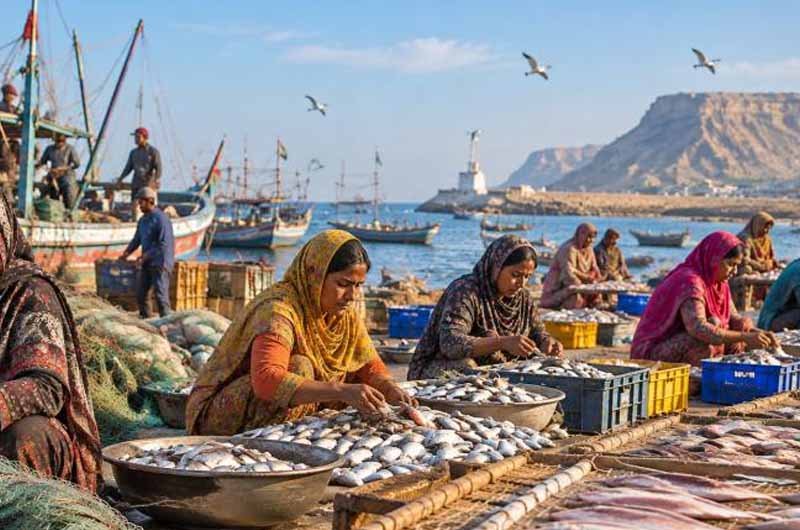
Along Pakistan’s 1,050-kilometer coastline—from Karachi’s Ibrahim Hydri to the shores of Gwadar—the steady rhythm of the fishing industry relies on a foundation of labor that rarely makes the headlines. While men steer wooden vessels into the Arabian Sea, thousands of women execute the grueling, uncredited work that keeps the maritime trade alive: mending nets, sorting catches on slippery stone piers, and curing fish under an unforgiving sun. This invisible workforce underpins coastal micro-economies, yet its workers remain largely absent from official labor statistics, stripped of economic protections, and overlooked in national policymaking.
While popular perception casts fishing as a strictly male profession due to visibility at sea, fisheries represent complex value chains extending far beyond harvesting. According to the Food and Agriculture Organization (FAO), women globally dominate pre- and post-harvest operations, including net repair, processing, marketing, and trade. The technical distinction between a “fisherman” and a “worker” often marginalizes these contributions; a woman sorting, drying, or selling fish directly adds economic value to the catch, regardless of whether official metrics classify her as a fisher.
This systemic exclusion comes at a severe physical cost. Research across coastal settlements like Ibrahim Hydri, Rehri Goth, and Shams Pir Island highlights the deep socioeconomic integration of female labor—and the harsh conditions accompanying it. A study by Nasreen Shah revealed that 73.79% of women in fish processing face unsatisfactory hygiene conditions, with 91.91% suffering from job-related physical ailments. When combined with unpaid household responsibilities, women bear a double burden that sustains both the domestic unit and the broader market.
As coastal communities grapple with shrinking catches, environmental degradation, and rising operational costs, ignoring this workforce leaves national economic policies fundamentally incomplete. Fully capturing the scope of Pakistan’s fishing sector requires measuring female labor through comprehensive survey data. Documenting these pre- and post-harvest contributions is essential to expanding access to microcredit, vocational training, occupational safety standards, and social safety nets for the women holding the coastal economy together.