by Aqeel Ahmed, Editor and Publisher, Food Business Pakistan.
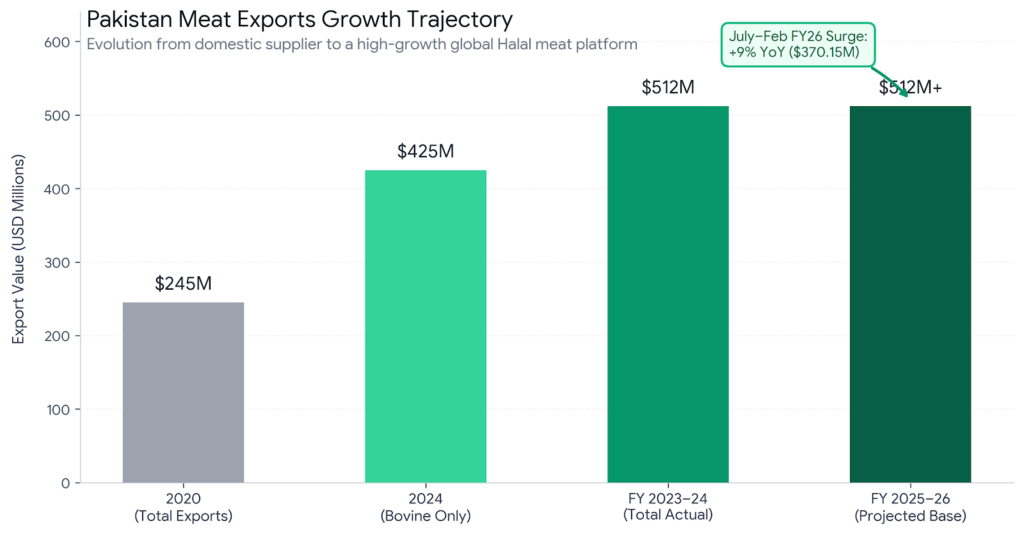
Pakistan’s livestock sector is undergoing a structural shift, evolving from a domestic supplier into a high-growth, specification-driven global platform. Total meat exports, including beef, mutton, and poultry, hit $512 million in the 2023–24 fiscal year. The momentum remains aggressive, with meat exports surging by 9% to $370.15 million during the July–February period of the 2025–26 fiscal year.
This upward trajectory reflects a strategic pivoting of a nation utilizing its massive herd size—over 6 million tons of annual meat production—to anchor itself as a vital player in the international halal meat marketplace.
Critical Drivers Fueling the Export Surge
The transformation of Pakistan’s meat export footprint is not accidental. It is driven by geographic advantages, market diversification, and strict regulatory alignments.
1. Strategic Access to China and Value-Added Processing
Securing approvals from the General Administration of Customs of China (GACC) altered the industry’s horizon. Historically restricted due to Foot-and-Mouth Disease (FMD) barriers, Pakistani processors pivoted to heat-treated, boiled, and cooked frozen boneless beef. As a result, exports to China skyrocketed by 239% year-on-year, yielding $14.32 million in late 2025 alone. Major corporate milestones include a $7.5 million cooked beef order secured by The Organic Meat Company Limited (TOMCL).
2. Solidifying the GCC Fortress
The Gulf Cooperation Council (GCC) remains the bedrock of Pakistani fresh and chilled meat revenues. Anchored by proximity and religious alignment, three countries command over 80% of the market share:
- United Arab Emirates: $176 million
- Saudi Arabia: $118 million
- Kuwait: $63.3 million
3. Shift from Raw Carcasses to High-Value Cuts
Historically, Pakistan relied heavily on low-margin chilled raw carcasses. Exporters are increasingly adopting global meat specifications, moving toward high-margin vacuum-packed boneless cuts, frozen blocks, and industrial-processing raw materials.
Core Structural Bottlenecks
Despite processing 6 million metric tons of meat annually, Pakistan only exports about 2% to 3% of its volume. To achieve global scale, the industry must overcome several structural hurdles:
- Fragmented Supply Chain: Animals are primarily acquired from open, weekly markets (mandis) rather than dedicated feedlot farms. This causes fluctuations in weight, age, and meat quality specs.
- Traceability and Disease Control: The absence of digital livestock tagging systems limits access to high-value Western and East Asian markets that demand rigid farm-to-fork origin logs.
- Cold-Chain Infrastructure Constraints: Transporting highly perishable fresh meat requires seamless temperature-controlled logistics, which remain underfunded in remote farming belts.
The Vision Ahead: Target $700 Million by 2028
The Ministry of National Food Security and Research has rolled out a comprehensive Halal Meat Export Policy. This structural transformation framework aims to scale total meat exports past $700 million by 2028 through targeted operational shifts.
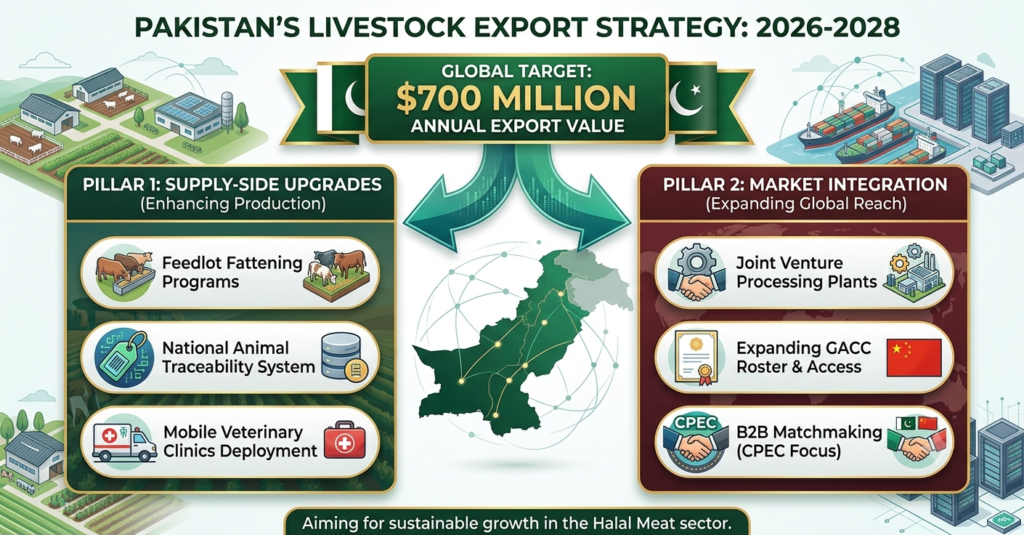
The provincial government of Punjab is executing public-private partnerships to set up specialized boiler units and feedlots designed to fatten 300,000 buffaloes/cows and 400,000 sheep/goats exclusively for foreign buyers. Concurrently, the state is rolling out modern veterinary hospitals and mobile dispensaries across rural tehsils to eradicate persistent livestock ailments at the doorstep.
As corporate processing plants deploy technology that aligns with global sanitary and phytosanitary metrics, Pakistan is transitioning from an opportunistic exporter into an agile agribusiness ecosystem. By matching its enormous livestock asset pool with modern value-added systems, Pakistan is on track to unlock a multi-billion dollar share of the global halal protein trade.