
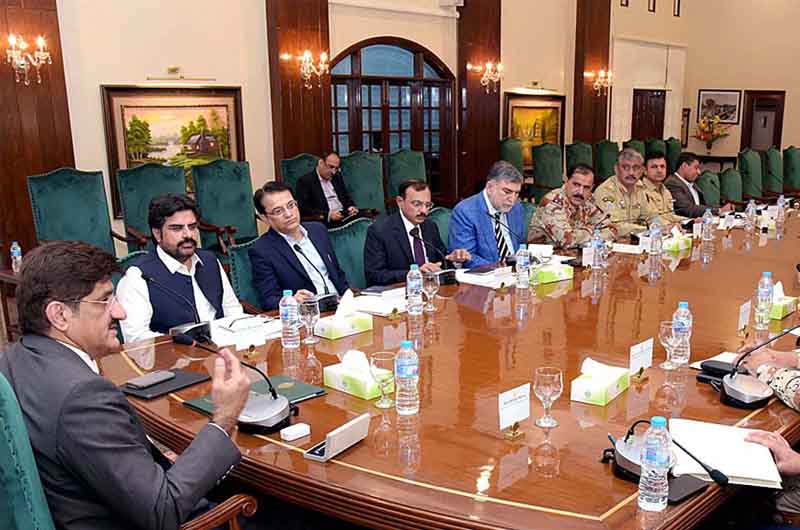
To safeguard food security and control staple prices across the province, the Sindh cabinet has authorized the import of 0.5 million metric tons (MMT) of wheat for the current fiscal year. The decision was reached during a meeting presided over by Sindh Chief Minister Syed Murad Ali Shah at Chief Minister House, addressing a projected provincial wheat deficit of 1.69 MMT.
Official data presented at the meeting indicated that Sindh’s estimated wheat supply for FY 2026-27 stands at 4.84 MMT, falling well short of the region’s total demand of 6.53 MMT. The approved import will be executed through the Trading Corporation of Pakistan (TCP) following a federal coordination framework.
CM Murad Ali Shah highlighted that the import strategy forms part of a broader, reform-minded agenda to stabilize market prices and guarantee sustainable grain reserves. The meeting was attended by provincial ministers, advisers, Chief Secretary Asif Hyder Shah, and other high-ranking officials.
Key Decisions & Legislative Reforms
- Shaheed Benazir Bhutto Institute for Democracy and Federalism: The cabinet finalized the board structure for the institute, established under the SBBIDF Act, 2024. Education Minister Syed Sardar Ali Shah was appointed as chairperson. The board—comprising members of academia, civil society, government departments, and the Bhutto family—will focus on advancing research and dialogue around federalism, democratic values, and constitutional governance.
- Vehicle & Taxation Regulations: Cabinet members reviewed proposed reforms concerning off-road vehicle de-registration, relief periods for motor dealers, and the mandatory continuation of third-party motor insurance during ownership transfers. CM Shah directed the Excise, Taxation, and Narcotics Control Department to revise the necessary legal amendments before returning for final legislative approval.
Restructuring the Public-Private Partnership Unit
In a bid to attract private investment and accelerate infrastructure developments, the cabinet approved transforming the existing Public-Private Partnership (PPP) Unit into a fully state-owned private limited company under the Companies Act, 2017.
- Capital & Funding: The new corporate entity will operate with an authorized capital of Rs8 billion, a paid-up capital of Rs2 billion, and an initial seed funding allocation of Rs500 million.
- Governance: The current Director General of the PPP Unit will assume the role of initial CEO. The move aims to resolve internal departmental capacity constraints and improve specialist staff retention. Amendments to the Sindh PPP Act were also approved to provide proper legal backing for the new structure.
Modernizing Land Management Laws
The cabinet reviewed the proposed Sindh Government Lands Management Bill, 2026, which is set to repeal and replace the century-old Colonisation of Government Lands Act, 1912. The draft legislation introduces market-aligned land valuation, competitive public auction requirements, defined allotment eligibility, updated enforcement guidelines, and formal grievance redressal frameworks across agricultural, commercial, industrial, residential, and public-use lands.
Other Cabinet Approvals
- Regional Flood Relief: Extended the Sindh Peoples Housing Initiative to construct 196 flood-resilient homes in Gilgit-Baltistan.
- Infrastructure Revenue: Imposed toll taxes on heavy vehicles traveling along the 135-kilometer Nawabshah-Ranipur Mehran Highway.
- Municipal Employment: Approved contract extensions for 254 employees within the Town Municipal Corporation (TMC) Lyari.